
(9/3) Exp. #20 - Metal Complexes of Dimethyl Sulfoxide

     In this experiment, three different metals were used: copper, palladium and ruthenium. It is cool to work with the same ligand on different metal centers, as it taught me a lot about what makes them complex in similar manners. It was hard for me to get a good grasp of hard and soft acid base theory, but that improved later on. This was a very fun a simple lab, and it was cool to learn about DMSO.
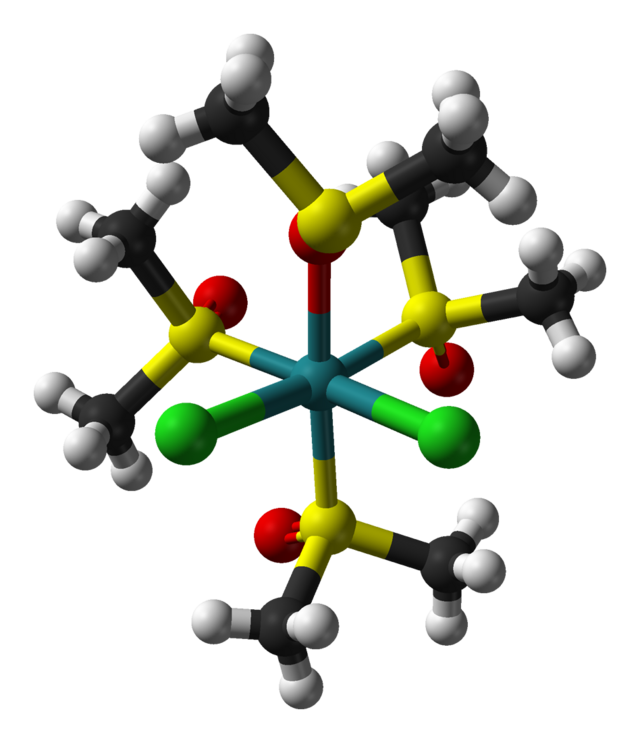
This is the structure of Ruthenium-DMSO complex with four DMSO ligands and two Cl ligands.


Comments

Popular posts from this blog

(8/27) Exp. #17 - Thione Complexes of Cobalt (II) Nitrate Hexahydrate

      This was our first experiment and I was unsure what to expect; this chemistry lab was much longer in class length than any other and that was kind of intimidating. It was also my first physical class since the beginning of the coronavirus pandemic. However, things ended up going relatively smoothly due to precautions and other measures taken by the UCF staff such as measuring our temperatures before entering the building, ensuring we wear our masks, and handing us experimental kits that are disinfected between uses.     While it did take long and the product wasn't completely pure, we did end up succesfully synthesizing two different Cobalt-mimt complexes. This experiment yielded a really clean FTIR spectra that was easy to break down to see different functional groups and contaminants, which was really a really good skill to sharpen up early in the semester as it would come to help with every single lab after this. A 75% yield was impressive, bu...

(10/8) Exp. #33 - Reaction of Cr(III) with a Multidentate Ligand

 This experiment was an easy one, and we were yet again using a compound I was familiar with, EDTA. This multidentate ligand exists in different states depending on the pH of the solution it is in, and thus required precise tuning of pH in order to successfully perform the desired reaction, and kinetics studies were performed to see how the different pH levels affected the reaction rate.

(10/1) Handout #2: Photocatalysis Using Ruthenium(II) tris-Bipyridine

 This was one of the experiments that I was looking forward to performing the most, but not for typical reasons. First of all, photocatalysis is such a cool and interesting field of chemistry that is ever evolving to change the future of energy production, so the reaction itself was awesome to learn about. However, more cool is heat sealing glass test tubes using a torch. God that stuff is cool and applicable to future glass involved projects.